Deploying on Custom Hardware
Configuration
By default, PhotonVision attempts to make minimal assumptions of the hardware it runs on. However, it may be configured to enable custom LED control, branding, and other functionality.
hardwareConfig.json is the location for this configuration. It is included when settings are exported, and can be uploaded as part of a .zip, or on its own.
LED Support
When running on Linux, PhotonVision can use diozero to control IO pins. The mapping of which pins control which LED’s is part of the hardware config. The illumination LED pins are active-high: set high when LED’s are commanded on, and set low when commanded off.
{
  "ledPins" : [ 13 ],
  "ledsCanDim" : true,
  "ledBrightnessRange" : [ 0, 100 ],
  "ledPWMFrequency" : 0,
  "statusLEDType": "RGB",
  "statusLEDPins" : [ ],
  "statusLEDActiveHigh" : false,
}
There are currently two types of status LEDs supported:
RGB(default): A singular LED mixing separate red, green, and blue inputsGreenYellow: A pair of independent green and yellow LEDs
For an explanation of the colors used for status LEDs, see Status LEDs
GPIO Pinout
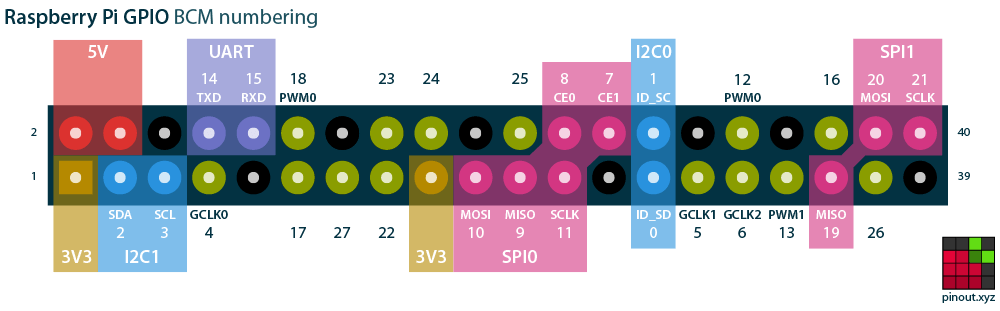
The following diagram shows the GPIO pin numbering of the 40-pin header on Raspberry Pi hardware, courtesy of pinout.xyz. Compute modules use the pin numbering from their respective datasheet.
Custom GPIO
If your hardware does not support diozero’s default provider, custom commands can be provided to interact with the GPIO lines. The examples below show what parameters are provided to each command, which can be used in any order or multiple times as needed.
{
  "getGPIOCommand" : "getGPIO {p}",
  "setGPIOCommand" : "setGPIO {p} {s}",
  "setPWMCommand" : "setPWM {p} {v}",
  "setPWMFrequencyCommand" : "setPWMFrequency {p} {f}",
  "releaseGPIOCommand" : "releseGPIO {p}",
}
The following template strings are used to input parameters to the commands:
Template |
Parameter |
Values |
|---|---|---|
|
pin number |
integers |
|
state |
true/false |
|
value |
0.0-1.0 |
|
frequency |
integers |
If you were using custom LED commands from 2025 or earlier and still need custom GPIO commands, they can likely be copied over. ledSetCommand can be reused as setGPIOCommand. ledDimCommand can be reused with edits as setPWMCommand, replacing any occurrences of {v} with $(awk 'BEGIN{ print int({v}*100) }') if your command requires integer percentages.
Hardware Interaction Commands
For non-Linux hardware, users must provide the hardware-specific command for executing system restarts.
Leaving this command blank will disable the restart functionality.
{
  "restartHardwareCommand" : "",
}
Note
This setting has no effect if PhotonVision detects it is running on Linux. On Linux, the restart is accomplished by executing reboot now in a shell.
Known Camera FOV
If your hardware contains a camera with a known field of vision, it can be entered into the hardware configuration. This will prevent users from editing it in the GUI.
{
  "vendorFOV" : 98.9
}
Device Name Branding
To help differentiate your hardware from other solutions, a device name may be set.
{
  "deviceName" : "Super Cool Custom Hardware",
}
Note
Not all configuration is currently presented in the User Interface. Additional file uploads may be needed to support custom images.
Example
Here is a complete example hardwareConfig.json:
{
  "deviceName" : "Blinky McBlinkface",
  "ledPins" : [2, 13],
  "ledsCanDim" : true,
  "ledBrightnessRange" : [ 0, 100 ],
  "ledPWMFrequency" : 0,
  "statusLEDType": "RGB",
  "statusLEDPins" : [ ],
  "statusLEDActiveHigh" : false,
  "getGPIOCommand" : "getGPIO {p}",
  "setGPIOCommand" : "setGPIO {p} {s}",
  "setPWMCommand" : "setPWM {p} {v}",
  "setPWMFrequencyCommand" : "setPWMFrequency {p} {f}",
  "releaseGPIOCommand" : "releaseGPIO {p}",
  "restartHardwareCommand" : "",
  "vendorFOV" : 72.5
}